Rail
By Enoden train
Kamakura to Hase Station
- RideAbout 7 minutes
- StopHase, third stop
- Walk afterAbout 7 minutes
Guides
Language
Currency
Check open daysstarting at $51 · plans can change freeTick-off list
In one line
The Great Buddha of Kamakura at Kotoku-in costs 300 yen for adults, with 50 yen more to go inside the statue.
Fees and hours
12 things to tick off
Tick things off as you go; this phone or computer remembers them.
0 / 12 ready
All done. The rest is the easy part: a seat on the coach.
Hold my placeThe Great Buddha of Kamakura is a huge cast figure that sits in the open air, with a hollow interior you can enter. Here are its real measurements, the fees, the hours and the easy way to reach it.
Editorial team, kamakuradaytrip.quest · Updated November 1, 2026 · A 7-minute read
Facts first
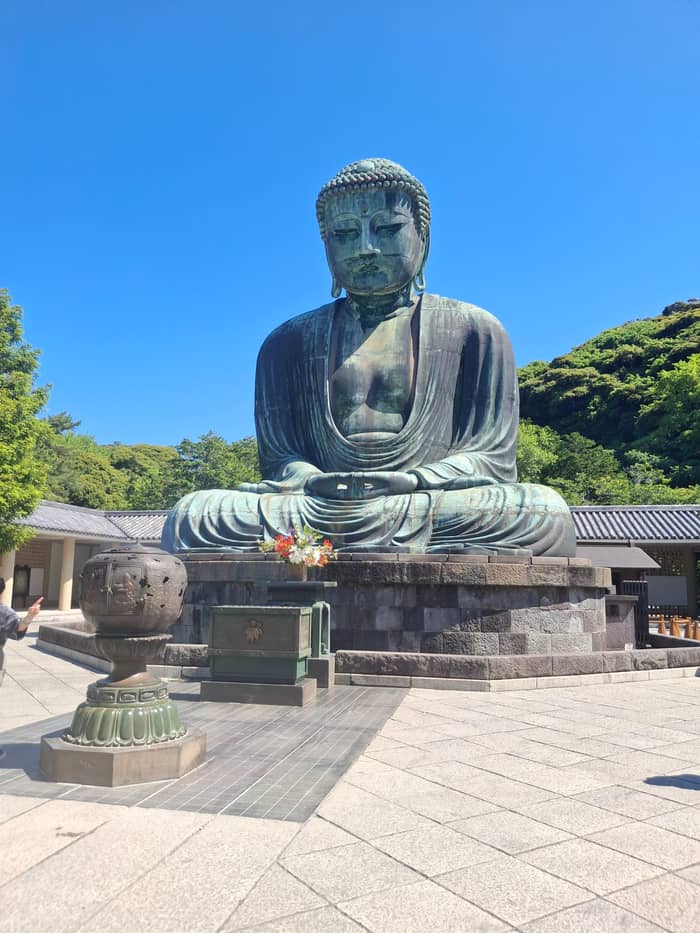
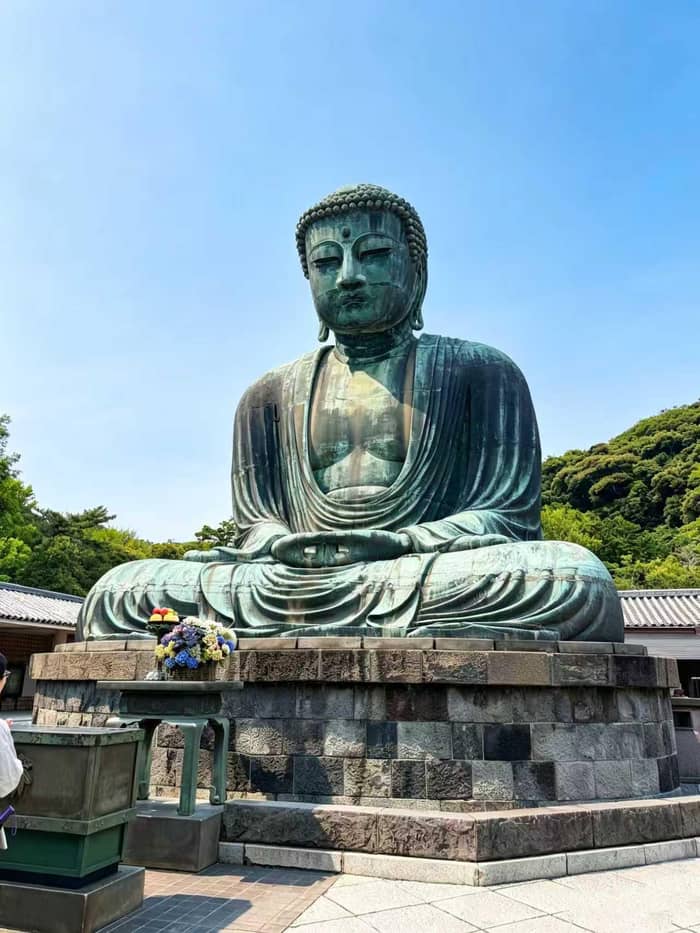
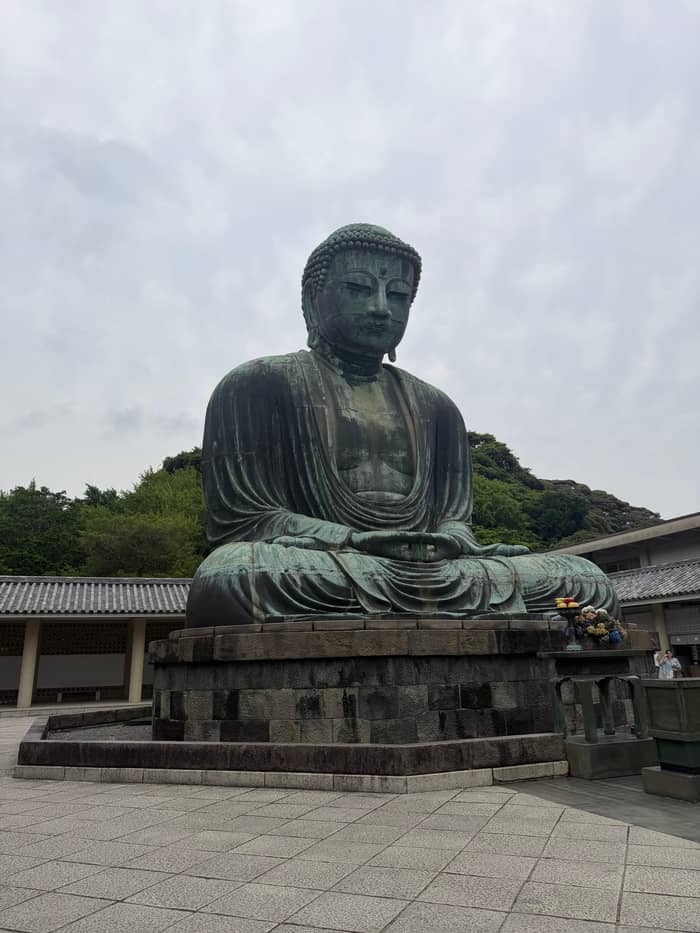
The statue, known in Japanese as the Kamakura Daibutsu, is the principal image of the temple Kotoku-in. It is a colossal image of Amida Buddha, and the temple itself calls it a National Treasure, some 11.3 meters tall and around 121 tons in weight.1 What sets it apart from most of Japan's big Buddha statues is where it sits: in the open air, with nothing between the figure and the sky.6
That open setting was not the original plan. The statue was first enshrined inside the Daibutsu-den Hall, and old records say the hall was damaged and finally destroyed by typhoons in 1334 and 1369, and then by a severe earthquake in 1498.7 Since then the figure has simply stood in the weather. You meet a dark, softened surface today, not a gleaming one, yet when it was built the statue was covered in gold, and traces of that gold remain on both cheeks.8
Construction began in 1252, according to the Azumakagami, a chronicle of the Kamakura shogunate, and the priest Joko is believed to have gathered donations to pay for it.9 The temple is candid that much about the building of the statue is unclear, and the artist has not been identified.9 Its style shows the influence of the Kei School of sculptors and of Song Dynasty China, and it counts as a typical example of Kamakura period Buddhist sculpture.10
A few measurements give you the scale before you arrive. The statue itself stands 11.312 meters high, and with its platform the height is 13.35 meters.13 The face alone is 2.35 meters long.13 The eyes are 1.00 meter wide, the mouth 0.82 meters wide and each ear 1.90 meters long.14 Hold those numbers in mind when you stand at the foot of the platform and tilt your head back.
The temple itself invites a comparison with the bigger Great Buddha of Todai-ji in Nara. That figure is 14.98 meters tall and weighs 250 tons, against 121 tons here.15 Kamakura has 656 hair coils on its head where Nara has 492.15 So the Kamakura Buddha is the smaller of the two, yet the temple stresses that it keeps essentially its original form, which is part of what makes it a valued example of Japanese Buddhist art.
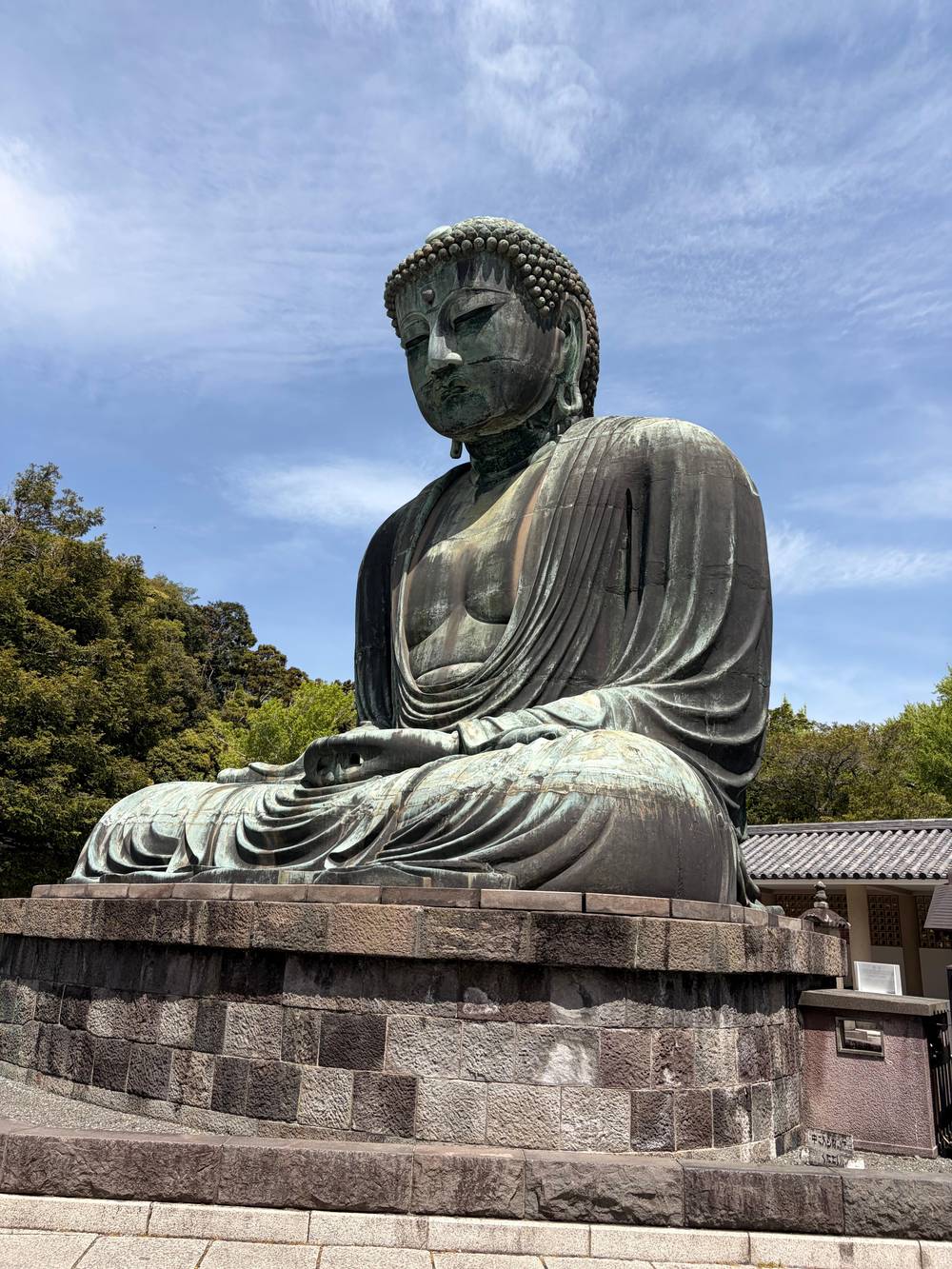
The body was cast, not carved. Molten bronze was poured between an outer and an inner mold, and the body alone needed seven large casting stages.16 Look at the figure as a stack of those stages and the seams start to make sense. Up close, the details reward patience: the nostrils are visible only from directly under the statue, and the bridge of the nose falls straight from the forehead.17
The simplest public route is the Enoshima Electric Railway, known as the Enoden. From Kamakura Station, take the line toward Fujisawa and get off at Hase Station, the third stop, about seven minutes away.4 The temple is then a seven-minute walk from the station.4 The little tram-like carriages are part of the outing, and the line also runs on to the coast toward Fujisawa.
The bus is the other option. From the East Exit of Kamakura Station, the Enoshima-dentetsu bus from stop 1 or the Keikyu bus from stop 6 runs to the stop named Daibutsu-mae, in about 10 minutes.20 If you arrive by car, note that there is no parking at the temple itself, so drivers use public lots nearby.21
From Tokyo, the Great Buddha is one stop on a long day rather than a destination of its own. Our Kamakura and Enoshima day trip runs for 9 to 9.5 hours and takes in Tsurugaoka Hachimangu and Komachi Street before Hase-dera, Kotoku-in and Enoshima. Check the closing time for your month in the next section before you plan the order of your day.
Decision helper
Choose by how much time and company you want
If I have an hour only
Enoden and a quick visit
The Enoden to Hase takes about seven minutes, then a seven-minute walk.4
If I want to see inside
Arrive well before 16:30
The interior closes at 16:30 and entry stops 10 minutes before.12
If I like a full day out
The coach tour day
Hase-dera and Kotoku-in are two of the stops on the listed route.
If I want a short private guide
A 1.5-hour private visit
A private listing covers Hase-dera then Kōtoku-in in 1.5 hours.
If Step-free access matters to me
Plan for bumpy ground
Ramps exist, yet many areas are bumpy; chairs can be borrowed from 9:00 to 16:00.19
Three ways in
Rail
Kamakura to Hase Station
Road
From Kamakura Station east exit
Guided
Hase-dera and Kotoku-in together
The grounds are open from 8:00 to 17:30 between April and September and from 8:00 to 17:00 between October and March.3 Visitors may enter up to 15 minutes before closing, and you do not need to reserve.3 General admission is 300 yen, and a child aged 6 to 12 pays 150 yen.2 Children under six pay nothing.2
The statue is hollow, and you can go inside it. That costs an additional 50 yen per person, and the interior is open from 8:00 to 16:30, with the last entry 10 minutes before closing.12,2 Selfie sticks are not welcome inside the statue and drones are not allowed in the precincts, but photos for personal use are free.24 The interior closes earlier than the grounds, so do not leave it for the last minutes of the day.
Mind the entry rules. If you leave the grounds you cannot re-enter without paying again.25 Smoking is not permitted anywhere on the grounds, and the temple has posted a notice restricting eating, drinking and bringing in food or drink, so finish your lunch before you arrive.26,22 Wheelchair loans and ramps exist, but the temple warns that many parts of the grounds are bumpy.19
Cost calculator
Type your group size to price four ways of seeing the statue.
Weigh up 4 choices
Type your group size to price four ways of seeing the statue.
≈
View≈
View≈
View≈
ViewStarting prices from GetYourGuide, converted at the ECB reference rate; the booking page shows the exact sum.
Step by step through the visit
Arrival
The ride from Kamakura takes about seven minutes.4
On foot
The temple is a seven-minute walk from the station.4
At the gate
A gate rebuilt in the 18th century, with a pair of guardian images.11
In front
A National Treasure, about 11.3 meters tall.1
Inside
Next
About 5 minutes on foot from Kotoku-in.5
Before you see the statue you pass the Nio-mon gate. It was moved together with its pair of Nio guardian images from another location and rebuilt at the beginning of the 18th century.11 It frames the first view well, and it is worth a pause, as from the gate the figure is seen in full, seated on its platform, with the temple trees closing in on both sides.
On the grounds, look along the corridor to the right as you face the statue. A pair of straw sandals 1.8 meters long and 0.9 meters wide, weighing 45 kilograms, rests on the wall.27 Children from Hitachi-Ota first wove a pair in 1951 and have given a new pair every three years since 1956, with the wish that the Buddha would walk around Japan bringing happiness to the people.27
You will also find the Kangetsu-do, a hall believed to have been part of the imperial palace in mid-15th century Hanyang, the present Seoul, and moved to Kotoku-in in 1924.28 The office issues commemorative goshuin seals: handwritten ones from 9:00 to 15:00 and printed ones from 8:00 to 16:30.23 The temple shop is open from 8:30 to 16:45 year-round, which makes it the last stop if time is short.23
Video
Ninjapan Solo Travel on YouTube · YouTube stays silent until you press play.
At the time it was constructed, the Great Buddha was covered in gold, traces of which remain on both cheeks today.
The Great Buddha pairs naturally with Hase-dera. The temple's own list of nearby places puts Hase Kannon about 5 minutes' walk from Kotoku-in.5 Hase-dera adds gardens and a view of the sea, and our page on Hasedera has the month-by-month flower calendar, so you can decide whether your date suits a visit there as well.
Walkers have two more options. The Kuzuharagaoka-Daibutsu hiking trails begin about 10 minutes' walk from Kotoku-in at the Daibutsu-zaka entrance, and about 15 minutes' walk away at the Oyato entrance.29 Zeniarai Benten, a shrine, is about 30 minutes on foot.29 The trail makes a quiet way into Kamakura's hills if the lanes around the statue are busy.
If you prefer a guide, one private listing built around exactly these two temples runs 1.5 hours, with Hase-dera first and Kōtoku-in second. A longer walking listing of 5 to 6 hours adds Komachi Street and Tsurugaoka Hachimangu before the two temples. Compare them with the long coach day above before you book.
FAQ
A child aged 6 to 12 pays 150 yen, children under six pay nothing and entering the statue adds 50 yen per person.2
From April to September the temple closes at 17:30, and from October to March at 17:00; the last entry is 15 minutes before closing.3
The temple has no parking and asks drivers to use a nearby public lot.21
The temple asks visitors to refrain from flying drones in the precincts and from using selfie sticks inside the statue.24
Sources
Questions about the Kamakura trip? We reply in minutes.